
Swiss Life Chief Economist Marc Brütsch and Swiss Life Wealth Managers CIO Peter Kaste highlight the key developments for the economy and financial markets in the fourth quarter of 2026 in the current quarterly video. Learn why geopolitical risks and multi-billion-dollar investments in future technologies are simultaneously challenging markets and opening up new opportunities.
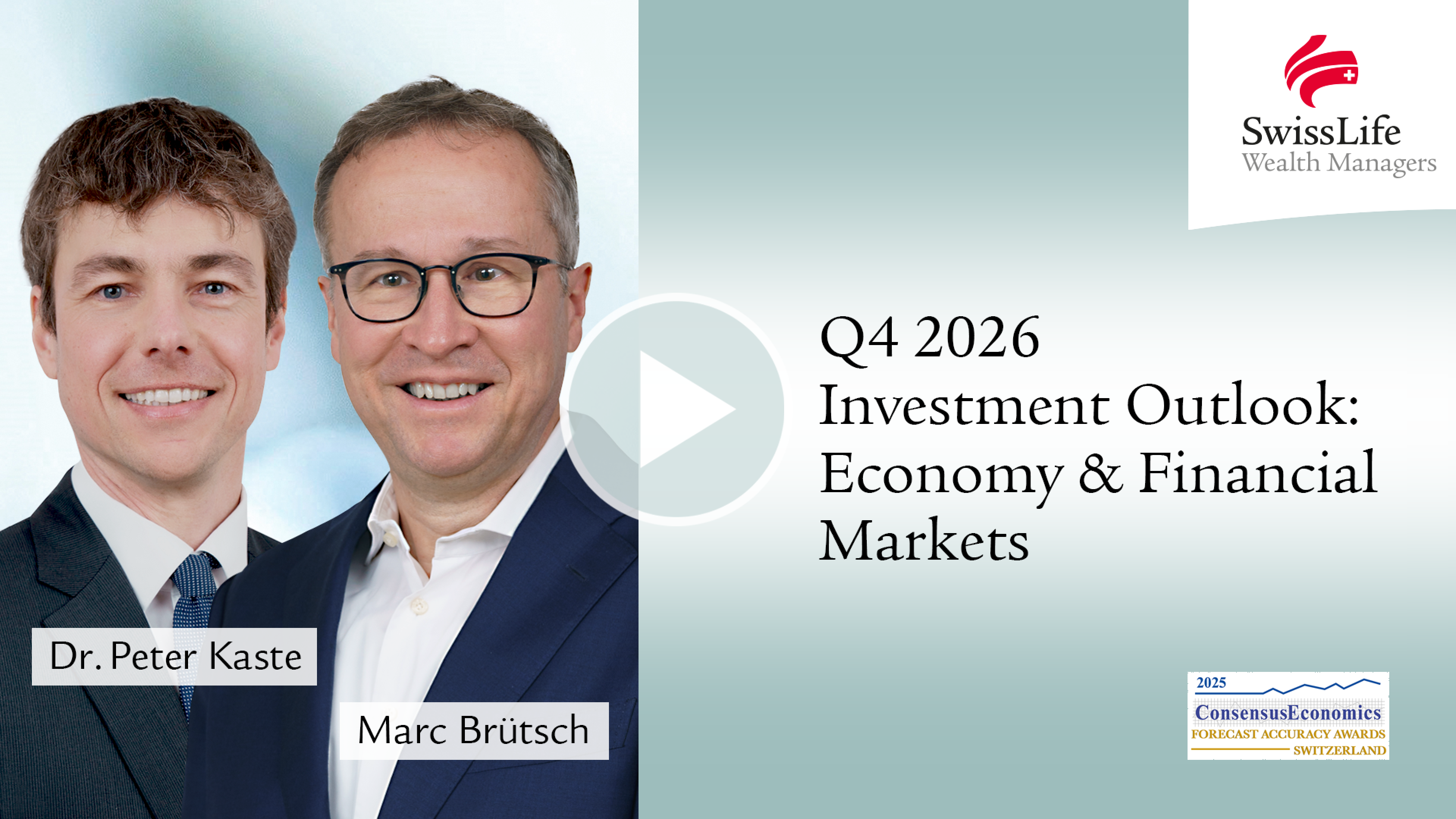
Please accept marketing cookies so you can watch this video. Cookie settings
What impact will the current developments have on your assets?
Our research won an award from Consensus Economics for the seventh consecutive year. You can take advantage of this expertise. In a non-binding expert consultation, we will clarify your questions, analyse your personal situation and show you the opportunities and risks.
What lies behind the current international challenges?
Geopolitical tensions, rising energy prices and the wave of artificial intelligence investments are currently shaping the market environment. The financial markets are caught between uncertainty and growth. But what developments are likely to have a particular impact on the coming months? What opportunities and risks does this entail for investors?
Marc Brütsch and Peter Kaste look at the key developments and show what investors should look out for now.
Geopolitical tensions in the Middle East remain a major risk factor for the global economy. Developments on the energy and commodity markets in particular can have an impact on inflation, interest rates and the economy.
At the same time, companies and governments around the world are investing billions in future technologies, artificial intelligence, infrastructure and energy supply. These investments create growth potential and support the economic development of many regions.
Investors are therefore less concerned about which headlines will dominate tomorrow, but about what developments could have an impact on their own assets over the long term.
Tip: Markets are evolving. Strategies often stay the same. Particularly in challenging times, it is worth obtaining an in-depth second opinion on your portfolio structure.
Even if financial markets have remained robust so far, investors should bear a number of risks in mind:
- Geopolitical tensions could negatively impact energy prices, inflation and market sentiment.
- Rising government debt levels and rising bond yields can exert valuation pressure on various asset classes.
- Strong expectations for individual growth areas, particularly in the technology sector, increase the risk of disappointment in the event of economic or corporate setbacks.
However, it remains crucial to always consider risks in conjunction with the long-term opportunities of an investment strategy.
Two major forces are currently at the centre: geopolitical uncertainty on the one hand and a global investment boom on the other.
While conflicts and energy prices increase risks, investments in artificial intelligence, infrastructure, defence and energy supply are providing important growth momentum.
The decisive factor will be the impact of these two developments on inflation, the economy and corporate profits. This provides important pointers for the further development of the financial markets.
The current environment offers opportunities but still requires broad diversification.
- Equities benefit from structural growth themes such as artificial intelligence, digitalisation and infrastructure investments.
- Bonds offer little potential return due to low interest rates in Swiss francs but can diversify portfolio risks in a negative demand shock.
- Real estate can continue to offer stability as a real asset.
- Commodities benefit from increased demand and reduced supply and can diversify geopolitical risks.
- Liquidity creates flexibility, but the interest earned on traditional savings accounts remains limited.
Which asset classes make sense in an individual case depends on your risk appetite, investment horizon and personal goals.
It is therefore more important than short-term forecasts to have an asset structure that remains sustainable even in different market phases.
Short-term headlines are rarely a good basis for investment decisions. It makes more sense to review your investment strategy regularly.
Questions investors should ask themselves:
- Will my strategy continue to align with my long-term goals?
- Are my assets sufficiently diversified?
- Do the risk and investment horizon still suit my current situation?
- Are there new opportunities that can be sensibly exploited?
Those who regularly review their strategy tend to make more informed investment decisions than investors who are primarily guided by the latest news.
Our experts would be happy to help you review your investment strategy and assess current developments in the context of your personal goals.

