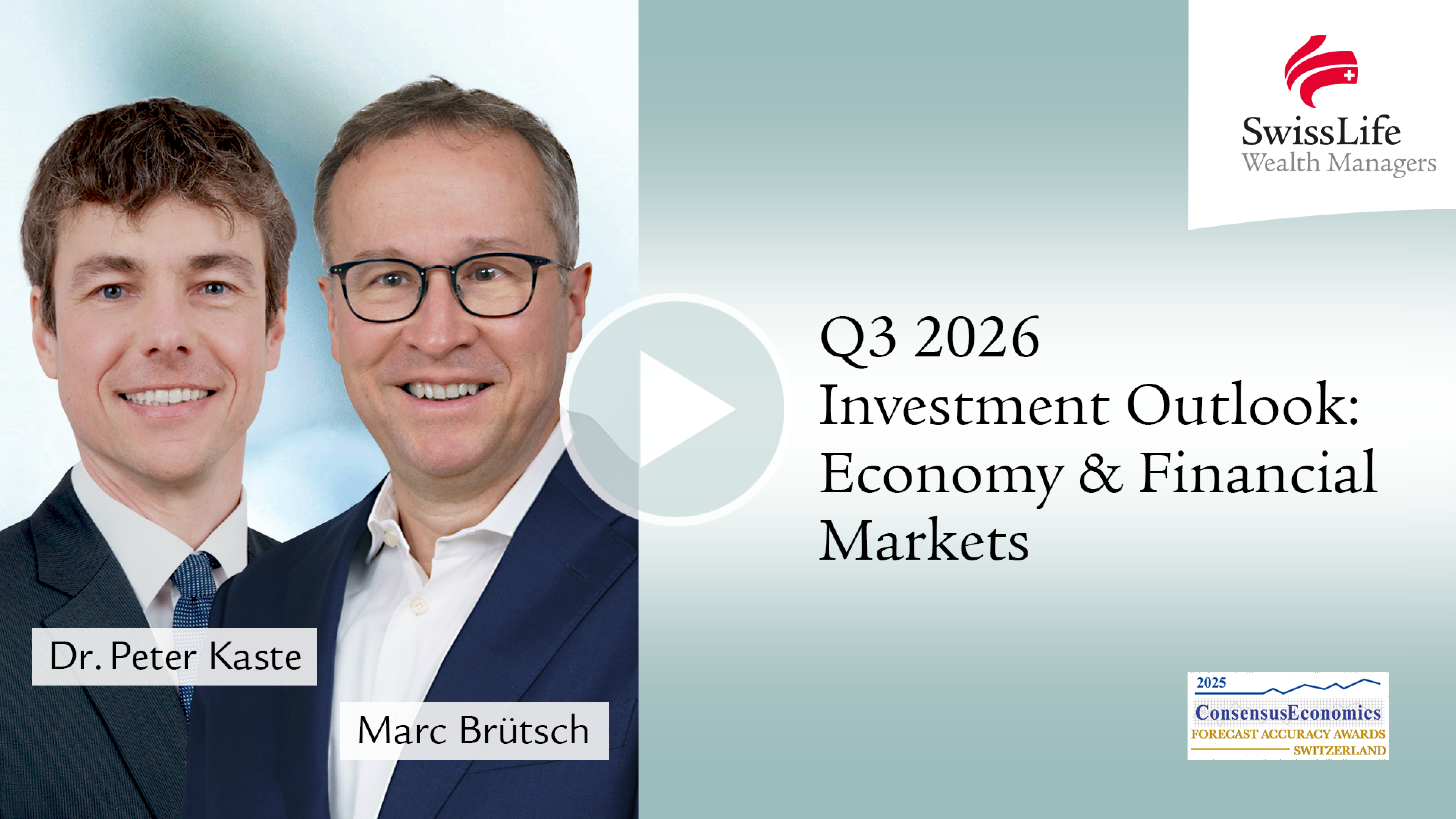
In the latest quarterly video, Swiss Life Chief Economist Marc Brütsch and Swiss Life Wealth Managers CIO Peter Kaste shed light on what we can expect on the financial markets in the third quarter of 2026 and explain what is important for investors both now and in the coming months.
Between boom and earthquake: financial markets facing decision on direction:
The past six months have shown just how quickly economic and market conditions can change: rising energy prices, ongoing inflationary pressure and geopolitical tensions have shaped the global economy.
While equity markets initially came under pressure, since April they have shown surprising resilience. By contrast, on the bond markets a sustained recovery largely failed to materialise.
In the coming three months, attention will mainly be focused on the Middle East, inflation, monetary policy signals from central banks and further investment activity, especially in artificial intelligence – a decisive phase for both the economy and the markets.
There are still opportunities out there for investors, but they need to choose carefully, maintain discipline and have a clear understanding of their own risk profile. However, anyone able to correctly assess short-term fluctuations instead of chasing them will be able to exploit opportunities even in a challenging market environment.
Please accept marketing cookies so you can watch this video. Cookie settings
Award-winning research for well-informed investment decisions
Our research won an award from Consensus Economics for the seventh consecutive year. The prize is awarded to the most accurate forecasts for growth and inflation – two key factors driving the financial markets. You can take advantage of this expertise. In a non-binding expert consultation, we will clarify your questions, analyse your personal situation and show you the opportunities and risks.
The first six months of 2026 were shaped by geopolitical tensions, rising energy prices and changes in interest rate expectations. The Iran conflict has increased inflationary pressure significantly and shifted monetary policy expectations. This led to a mixed performances from bonds and equities.
- Geopolitics: The Iran war and the resulting uncertainty in the Middle East weighed on the economy and markets.
- Inflation and interest rates: Rising energy prices increased inflationary pressure, while the monetary policy we can expect is becoming less expansive.
- Fixed income: Rising interest rates are putting pressure on prices.
- Equities: After initial weakness, equity markets have staged a strong recovery since April, supported by hopes of an end to the Iran war and strong corporate earnings.
Our baseline scenario assumes a moderate economic upturn. A continued opening of the Strait of Hormuz and a resilient private sector to support growth are key.
Geopolitical uncertainties remain a major risk factor, while China is gaining in importance and increasing global competitive pressures.
- Economy: The moderate upswing is expected to continue, supported by a resilient private sector and high investment activity.
- Geopolitics: The situation remains fragile. Despite efforts for de-escalation, if tensions re-escalate, this could again weigh on energy supply and trade.
- Inflation: We expect inflation to decline following the temporary rise in energy prices.
- Financial markets: In the baseline scenario, capital markets will generate solid returns, especially equities and real assets. However, geopolitical developments and interest rate movements are likely to continue to significantly impact how markets develop.
- Asset classes: There are still differences between equities, bonds, real estate and commodities. If alternative scenarios arise, this could lead to increased volatility.
Having a clear investment strategy is key, especially in a challenging market environment. It provides guidance, helps to classify risks and helps prevent short-term market movements from leading to hasty decisions.
- Strategy: Having a clear investment strategy forms the basis for well-founded investment decisions.
- Discipline: In volatile market phases, it is important not to be swayed by headlines and scaremongering, but to stick to your long-term plan.
- Classification: Scenarios help to better understand risks and opportunities.
- Perspective: Short-term fluctuations should not be overrated. The long-term investment horizon remains relevant.
Scenarios are a key tool for investors – especially in a fast-moving world shaped by uncertainty.
Scenarios help to classify uncertainties in a structured way and to think about possible developments at an early stage. They show not only what is likely, but also what opportunities and risks may arise if the environment develops differently than anticipated.
- Classification: Scenarios provide guidance and show what could happen if different relevant factors develop differently.
- Preparation: They help to anticipate possible developments and their consequences for the economy and markets at an early stage.
- Basis for decision-making: Scenarios create a sound basis for investment decisions and help to strategically structure portfolios.
The latest medium-term scenarios for the Swiss Life Group show which developments could shape the economy and financial markets in the next three years, including an assessment of how artificial intelligence is influencing market structures, corporate profits and investment opportunities.
Scenarios show how the economy and markets could develop under different assumptions. This makes it easier to compare potential market trends and structure portfolios in a more strategic manner.
- Comparison: Scenarios show how different developments can influence individual asset classes in different ways.
- Positioning: They help build stable and forward-looking portfolios and seize opportunities in a targeted manner.
- Risk awareness: They sharpen our view of risks without losing our long-term investment focus.